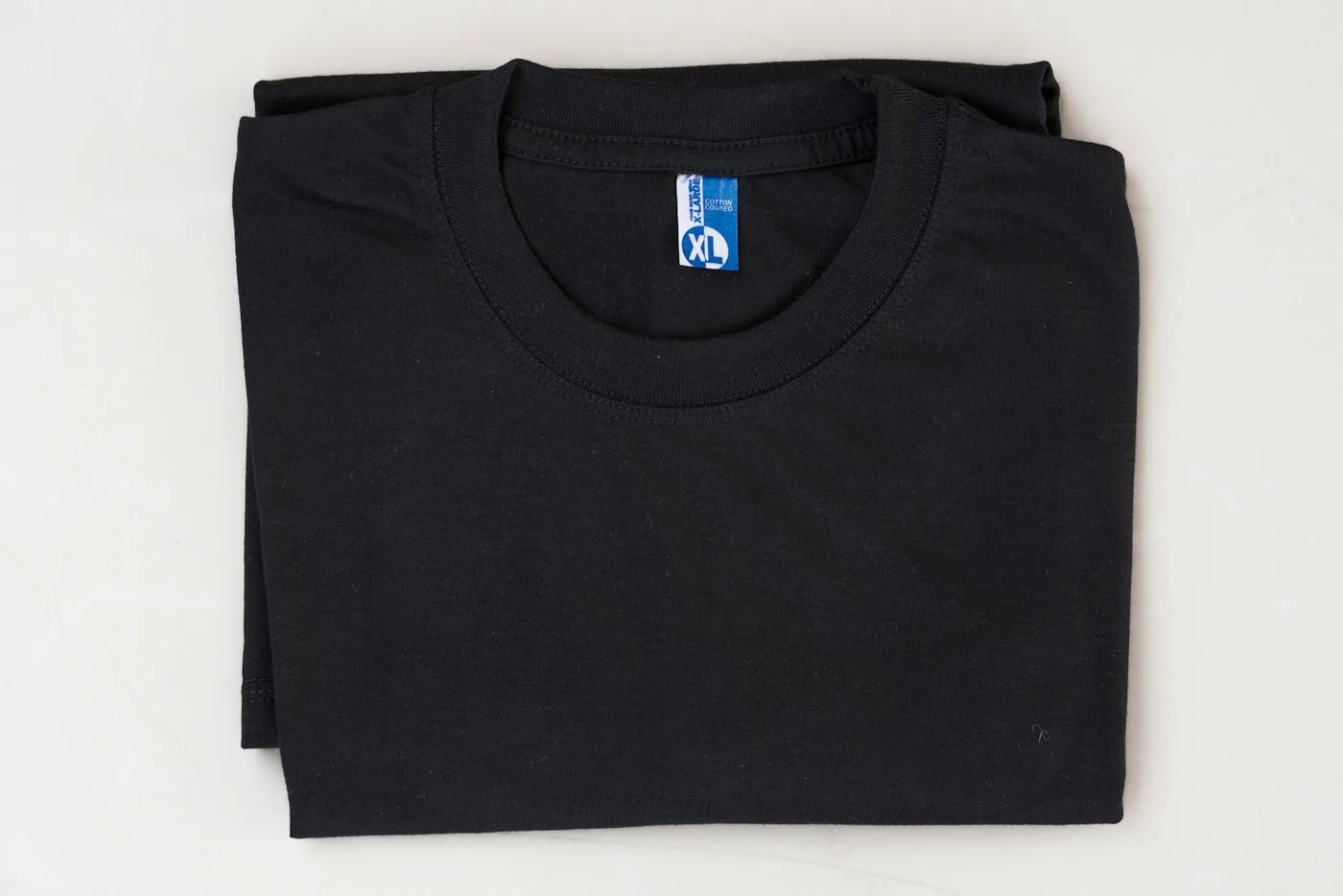
Why 200gsm sits where it does
Below about 180gsm a jersey starts to be transparent against a dark print and stretches at the neckline during the first months of wear. Above about 240gsm the same shirt becomes a heavyweight product with a different customer — structural, warmer, and usually sold at a higher price point.
At 200gsm the fabric has enough body to hold a screen-printed edge without a heavy deposit, which means a normal print looks clean and the hand feel stays soft. It also drapes enough to read as a retail tee rather than a promotional one.
The practical consequence: 200gsm is the weight that lets one blank serve a print shop, a small brand and a uniform programme without changing the SKU.
Regular fit: the shape that needs no explanation
Regular fit is a straight body with a modest shoulder drop and a hem that sits at the hip. It is not boxy and not slim, which is exactly why it is the easiest fit to sell: most customers already know their size in it.
A side-seamed body twists less after washing than a tubular body and holds a straighter line down the sides. That is the difference a buyer sees after ten washes, and it is the reason a retail programme pays for the seam.
Collar construction decides how the fit ages. A taped neck with a 2×2 rib holds shape; a single-stitch collar on a light rib starts to wave and the shirt reads as old before the fabric does.
Measurements to expect
The numbers below are the pattern our 200gsm regular fit is cut to, measured flat, one side of the garment. Tolerances are ±1 cm on body measurements and ±0.5 cm at the chest, which is the normal production range for cut-and-sew knitwear.
- S — half chest 50 cm, body length 68 cm
- M — half chest 53 cm, body length 70 cm
- L — half chest 56 cm, body length 72 cm
- XL — half chest 59 cm, body length 74 cm
- 2XL — half chest 63 cm, body length 76 cm
- 3XL — half chest 67 cm, body length 78 cm
When to go heavier, and when to go lighter
Go heavier (240–300gsm) when the product is streetwear, when the print covers a large area, or when the customer expects a structured body. A 200gsm shirt with a full-front print is workable but not the best use of the weight.
Go lighter (160–180gsm) for promotional runs, event tees and warm-climate retail where cost per unit dominates. Below 160gsm the fabric is usually too light to hold a clean neckline.
Printing on a 200gsm blank
Screen printing is the natural match: the surface is stable enough to hold a clean edge at 180–230 mesh, and a one to four colour design runs at the lowest per-piece cost above roughly fifty units.
DTG works well on light colours and gets a softer hand than on a heavy body, because the ink can sit in the fabric rather than on top of it. On dark colours the white underbase still fades first, in the 15–25 wash range.
Puff is possible but not ideal: 200gsm is near the lower limit where the knit stays stable enough for the ink film to break cleanly at the edge.
This is the mid-weight entry in the blank programme. The other two weights are documented on the blank hub: 160–180gsm for promotional work and 240–350gsm for premium and streetwear bodies.
Related pages