T-shirt guide
Three fits, four weights
Fit and weight are two separate decisions, and most first orders confuse them. Fit is a pattern decision — it moves chest, shoulder and length together. Weight is a fabric decision — it changes how the garment holds its shape and how a print sits on it. Choose the weight first, then the fit.
Difference between the fits
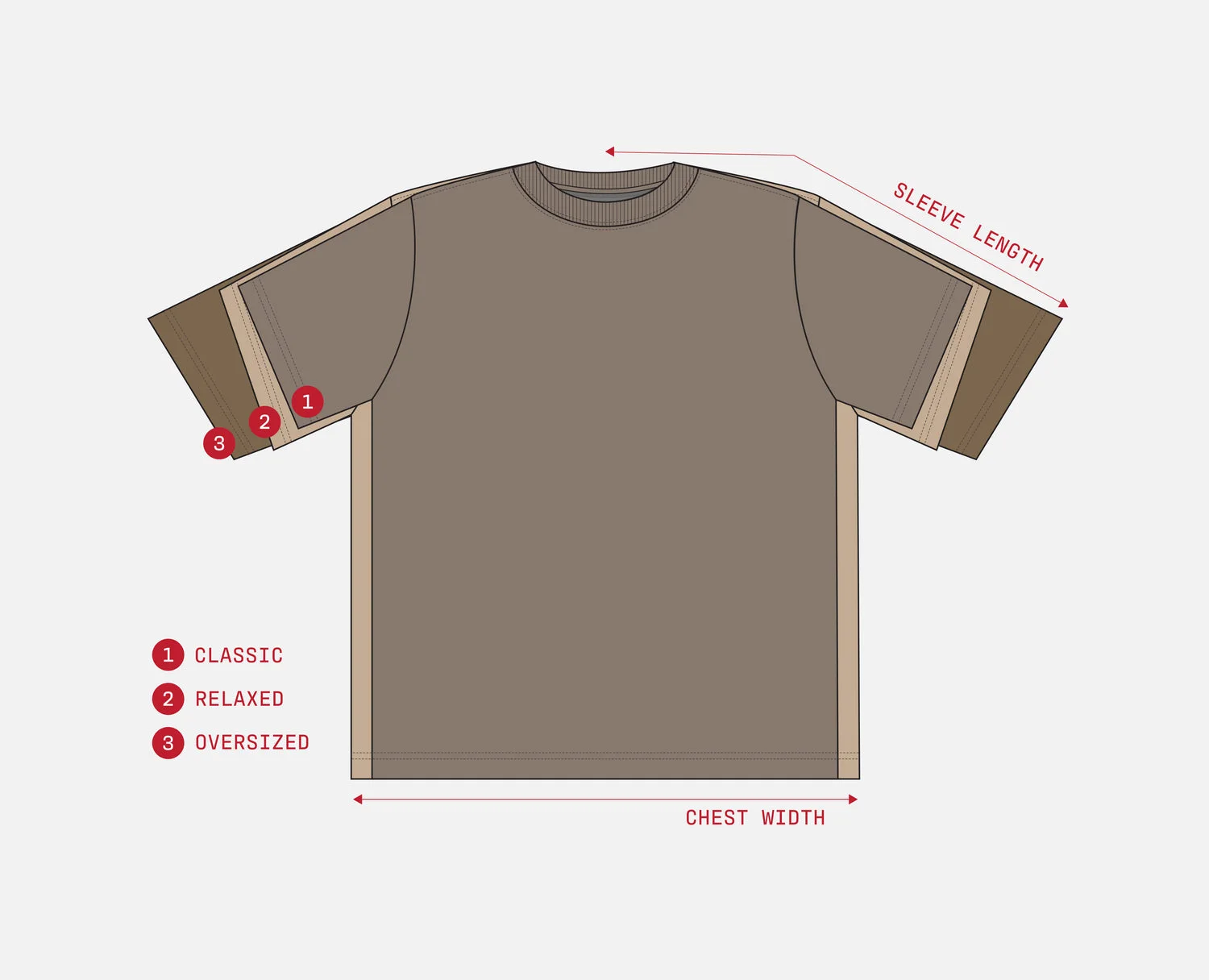
① Classic fit
Follows the body with a modest shoulder drop and a hem that sits at the hip. It is the fit most customers already know their size in, which is why it is the least risky first SKU for a retail programme and the easiest to reorder.
② Relaxed fit
Wider through the chest and body, with the same shoulder as the classic. The extra width comes from the body panel rather than from a dropped shoulder, so the garment reads as comfortable rather than oversized — and it does not change the sleeve angle.
③ Oversized fit
A different pattern, not a scaled-up classic: the body is wider, the shoulder drops past the shoulder bone, and the length is shorter. That combination is what produces the boxy silhouette. Take your normal size if you want the intended look; size down if you want it to read as a regular tee.
What we run
| Code | Style | Weight | Fit | What it is for |
|---|---|---|---|---|
| BSF-101 | Heavyweight t-shirt | 300gsm | Oversized / drop shoulder | Streetwear, structured body, heavy print coverage |
| BSF-102 | Midweight t-shirt | 240gsm | Regular, true to size | Retail basics, uniform, the safest first SKU |
| BSF-103 | Boxy oversized t-shirt | 260gsm | Boxy, wide body, short length | Boxy streetwear block, print-led designs |
| BSF-104 | Long sleeve t-shirt | 230gsm | Loose, ribbed cuff | Layering, two-season programmes |
Codes are ours. Supima cotton and recycled-cotton bodies are not part of the stock programme — they are made to order with fibre documentation, and we quote them per project rather than list them as catalogue weights.
How weight changes the fit decision
A 240gsm body in a relaxed fit drapes; the same fit at 300gsm stands away from the body and reads as oversized even though the pattern is unchanged. That is why the weight has to be chosen before the fit: a pattern approved on a midweight fabric will behave differently the moment it is cut in a heavy one.
The same applies to length. Heavy single jersey resists vertical stretch, so it hangs straighter and slightly shorter than a midweight of the same nominal length. If you are moving a style from 240gsm to 300gsm, re-measure the sample rather than assuming the fit carried over.
How to choose, in three questions
- What will the customer wear it for? Everyday retail → 240gsm classic. Streetwear or print-led → 300gsm oversized.
- How big is the print? A full-front print needs a stable body; a left-chest hit works on anything.
- Will it be reordered? If yes, pick the weight you can keep in stock rather than the one that photographs best.
Questions
What is the difference between classic, relaxed and oversized fits?
Classic follows the body with a modest shoulder drop. Relaxed adds width through the chest and body without changing the shoulder much. Oversized widens the body, drops the shoulder and shortens the length — it is a different pattern, not a scaled classic.
How do I choose between a 240gsm and a 300gsm t-shirt?
By what the garment has to do. 240gsm is the retail-safe weight: it holds a print edge, drapes and sells across ages. 300gsm is a structure — it holds a wide body without sagging and takes a heavy ink deposit, which suits streetwear and print-led brands.
Does a heavier shirt shrink more?
Not if it is pre-shrunk. Weight and shrinkage are separate decisions. Our heavy bodies are pre-shrunk to 1–2% on the first wash; an un-shrunk 300gsm garment can move 4–5%.
Can I get a sample in each fit?
Yes, and it is the right way to choose. Order one sample per fit on the same body colour, then measure all three against each other rather than against a size chart.