Cost reference
How embroidery cost is actually calculated
Embroidery is the only decoration priced by a number nobody can see from the artwork: the stitch count. Everything below is about how that number is produced, how to get a usable estimate before digitising, and which decisions raise it — because those decisions are made by the buyer, not by the machine.
Why stitch count is the price
A needle path costs time, thread and machine wear. Ten thousand stitches take roughly ten times as long as one thousand on the same machine at the same speed, so the count is the cost driver in the same way area is for screen printing.
The count is set by the digitised file, which is a paid setup step done once per design. That is why a supplier can quote a repeat order cheaply and a first order expensively on an identical garment.
The grid method, in five steps
Before a file exists, the standard way to plan a budget is a 25 mm grid — one inch per square. The diagram below is the reference: a filled square is about 2,000 stitches, a quarter of one is about 125.
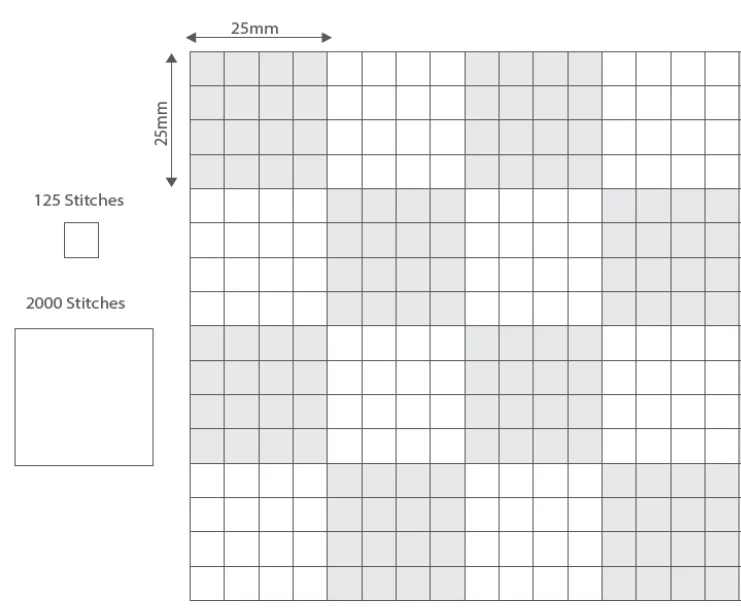
Print the grid
Each square is 25 mm (one inch). Print at 100% scale — a scaled grid is the most common reason an estimate is out by half.
Lay the artwork over it
Place the logo at the size it will actually be sewn. A logo evaluated at screen size and then reduced to a 60 mm chest hit will estimate nothing useful.
Count the filled squares
Count partially filled squares as half. This is the step where the estimate is won or lost; be honest about open space inside the letters.
Multiply
Filled squares × 2,000. A quarter square is 125 stitches, so a one-inch letter that covers sixty percent of its square lands near 1,200.
Add the edges
Outlines, drop shadows and straight rules under a logo add roughly 200 stitches per inch of length.
The reference numbers decorators use
| Rule | Number | Why |
|---|---|---|
| Solid area | ≈ 2,000 stitches / inch² | Satin or fill at normal density |
| Quarter square | ≈ 125 stitches | Useful for small accents and dots |
| Minimum letter height | ≈ 5 mm (3/16") | Below this, thread cannot hold the shape |
| Letter height cost | ≈ 100 stitches per 6 mm | Text is usually outlined, not filled |
| Drop shadow | + ≈ 200 stitches / inch | Extra pass along the shadow edge |
| Straight rule under a logo | + ≈ 200 stitches / inch | Dense satin column |
Treat these as planning numbers. The digitised file decides the real count, and the real count decides the price.
Where the grid method goes wrong
It measure area, not density. A solid block and an outline of the same footprint cover the same squares and differ by a factor of three in stitches. Two logos that look identical at thumbnail size can estimate 4,000 and 11,000.
It also ignores what the fabric demands. A stretch jersey needs underlay and often a cut-away backing to stop the logo puckering; that underlay is extra stitches, and the backing is a separate material cost.
How to spend less without a worse logo
- Simplify before digitising. Remove gradients, hairlines and small reverses; each one forces the digitiser to add stitches to hold the edge.
- One colour where possible. Tonal embroidery — one thread on a dark body — is the cheapest luxurious-looking option and needs no underbase.
- Keep text above 5 mm. Below that the fix is a redraw, and a redraw costs more than the stitches it saves.
- Combine placements on one file. Chest and sleeve in the same setup share the hooping time.
Questions
How many stitches are in a square inch of embroidery?
About 2,000 for a solid area. A quarter of a square inch is roughly 125 stitches. These are planning numbers, not a quote: density, underlay and stitch direction all move the real figure.
How do I estimate stitches from a logo without a digitised file?
Print a grid where each square is 25 mm (one inch), lay the artwork over it, count the filled squares, and multiply by 2,000. Add about 200 stitches per inch for outlines, drop shadows and straight rules beneath the logo.
Why can two logos of the same size have very different stitch counts?
Because density is not the same as area. A solid block fills every square; an outline covers the same footprint with a fraction of the stitches. Satin borders, underlay and small text all raise the count on the same silhouette.
Is small text cheaper than large text?
Not proportionally. Letters below about 5 mm (3/16") stop being legible in thread regardless of stitch count, so the design gets redrawn — and a redraw costs more than the stitches it saves.
Does fabric affect the stitch count?
Yes. A stretch knit needs underlay and often a cut-away backing to stop the logo puckering, and that underlay is extra stitches. A stable woven fabric can run a lighter file.
Why is the estimate not the final price?
Because the price comes from the digitised file, and digitising is a paid step done once per design. The grid estimate is for planning a budget; the digitised count is what the machine runs.