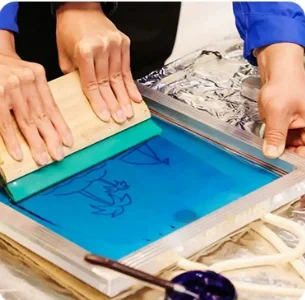
Screen printing: the workhorse
One screen per colour, ink pushed through a mesh, then cured. It is the cheapest per piece above roughly fifty units on cotton, and the most durable finish on a heavy body. It cannot reproduce a photograph and every extra colour adds a screen and a setup.
The mesh decides the deposit. 110–160 threads per inch passes a heavy film for a bold block or a white underbase on dark fabric; 230–305 passes a thin film for fine type and halftones. Cure is 150–160°C through the full ink film, not just at the surface.
- Best at: 100+ pieces, 1–4 spot colours, cotton.
- Watch: five colours means five setups before the first shirt.
DTG and DTF: the digital pair
DTG prints water-based ink directly into the fabric: no screens, no setup, soft hand, best on 100% cotton in light colours. On dark cotton it needs pre-treatment and a white underbase, and that underbase is what fades first, typically in the 15–25 wash range.
DTF prints onto a film, coats it with adhesive powder, cures it, then presses it onto the shirt. It holds colour on dark, polyester and blended fabric far better than DTG, but sits on the surface as a film rather than becoming part of the fabric.
- DTG: cotton, light colours, soft hand, short runs.
- DTF: dark colours, polyester and blends, film edge is the failure point.
Puff and reflective: texture, not colour
Puff carries an expanding agent in the ink. It stands 0.5–1 mm proud and needs bold shapes: strokes and gaps under about 2 mm close up, and type under roughly 12 pt disappears. High-density printing is the alternative when the raised area needs a crisp edge and fine detail.
Reflective transfer uses retroreflective film pressed onto the garment. It is a visibility product rather than a colour product, and it behaves like any transfer film: the edge is what lifts, not the ink.
Adhesion is tested, not assumed
The same ink behaves differently on a 160gsm jersey and a 350gsm knit. A light, stretchy jersey moves under the screen, so the film lands on a surface that is already deforming — the print feels stiff relative to the garment and cracks sooner at the edges.
Every method is wash-tested on the actual fabric in the actual colour before the bulk run: a domestic wash cycle, then a visual read of cracking, edge lift and colour shift. A print that is surface-dry but under-cured looks perfect in the shop and fails on the first wash.
Artwork rules that save the run
Send vector at final print size, with the placement and dimensions marked. For screen printing, separate spot colours rather than sending an RGB file; each separation is a screen and a cost line.
For puff, redraw anything below 2 mm. For DTG and DTF, send the file at 300 dpi at final size — a small JPG scaled up is the most common cause of a soft-looking print.
- Screen: vector, spot colours separated, at final size.
- DTG / DTF: 300 dpi raster at final size, or vector.
- Puff: redraw strokes under 2 mm; no hairlines, no fine serifs.
Printing is one of two decoration services here; the other is embroidery. Both run on the same production floor as the blank programme, which is why a decorated order can ship from one factory instead of two.
Related pages